Hanging on the wall of my cubicle at work, I have quite a number of geek related items, from web comics involving SQL jokes to a detailed mechanical diagram of K-9 from Doctor Who. Always in my field of vision, though, are some small photos of my computer science heroes. It’s not surprising that many non-geeks haven’t heard of these people – but it is sad. Most people know media stars like Tom Cruise, Eminem, and Michael Jordan, who are rightfully talented in their fields – but mention John von Neumann, Max Planck, or Kurt Gödel, and most won’t have heard of them. This is a shame, because it is the mathematicians, scientists, and engineers of history who have made many things we now enjoy possible. Given that we live in a place that gives an average salary of 2.7 million dollars to baseball players, it’s nice to at least recognize the people that make an incalculable impact on life.
The Man, The Legend
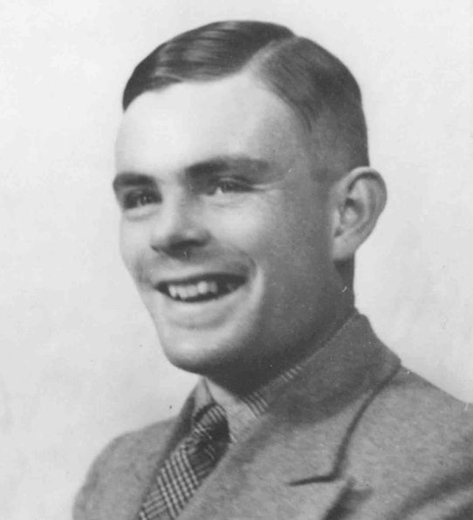
One of these people, regarded as the father of Computer Science, is one of my biggest heroes, and goes by the name Alan Turing. Born in 1912, Turing started life off in a world that had never seen a finished computer. The field of mathematical logic was new and fresh, with the work of mathematicians like Boole, De Morgan, Peano, and Hilbert (among others) paving the way for computation theory and algorithms.
 WWII Work
Turing made contribution after contribution not only in this new field of Computer Science, but also to the world as a whole. During World War II he was a cryptanalyst, designing a device and doing work that would decipher encoded German communications, giving the Allies a key advantage.
Artificial Intelligence
Turing also had a keen interest in the ideas of computation and intelligence, and how the two related, ideas that would later found the area known as Artificial Intelligence. He developed the Turing Test which addresses, at its roots, that there is no distinction between intelligence and something that acts truly intelligent. It was a concept that is still not even truly accepted today by all; an effort in logic to dispel the idea that intelligence is somehow ineffable.
The Turing Machine
From pattern work with the mathematics of biology, to theory of computation, Turing gave more and more to the community. One of his biggest contributions (and my favorite part of his work), an idea that continues to pervade every inch of a computer from hardware to operating system to software, from a word processor to a video game emulator, is that of the Turing Machine. Some (like myself) would go so far as to say it pervades every aspect of the Universe.
More on This Concept
To give some background, the idea of a Turing Machine is a simple machine that can perform algorithms to compute a value. The idea of a Universal Turing Machine is one that can compute any Turing Machine, and hence anything computable, including OTHER Universal Turing Machines. This is what a computer is – it is a device that can, given enough time, compute anything that can be computed. Not only that, but since computers are themselves computable (i.e. computers work algorithmically), any computer can emulate any OTHER computer. This is proven all the time, from video game emulators, to Java, .NET, and virtual machines (including my Gruepal project!). The Turing machine speaks to the heart of Functionalism, which is that it is not the “stuff” that matters, but the function the “stuff” performs. E.g. you can make a calculator out of silicon chips, steam through pipes and valves, or virtually on a computer (e.g. doesn’t physically exist at all), but it still adds 2+7 the same, as long as the functionality is intact.
I won’t jump too far off course from Turing, but I can’t stress how important this concept is, and one that I guarantee we will continue to discover more about in the decades to come. In a sense, the human brain is very much a Universal Turing Machine (though fallible), as you could, mentally or on paper, emulate any computer or machine algorithmically – as many programmers do constantly every day in their line of work. And with the Universe giving rise to everything, all Turing machines, and having a tendency to recurse, there is a good chance (some will say), that this whole great ball of wax is just one big Universal Turing Machine recursing over and over into other Universal Turing Machines. It is one of the reasons I tell people that Computer Science has more to do with the Universe itself than any pile of microchips.
The Final Years
Regardless of how deep or far the philosophy goes though, there can be no denying the role Alan Turing played in the mathematics behind computability and computers. His absolutely life changing work was rewarded by his government giving him the choice of imprisonment or estrogen injections when it was found out he was homosexual. Homosexuality was still illegal in the UK at this time, and though he had literally helped save the world only a few years before, this meant nothing in the light that he was attracted to men. After the effects of the hormones and ostracism from the life he knew, he committed suicide by eating an cyanide laced apple.
I remember the first time reading the details about Turing’s death, and how just pissed off and horrified I was about the whole thing. You’d think times had changed since Galileo, but they were still going strong in 1952. It is a relief, though, that since then he has become such an honored person, with a prestigious award and many memorials named after him.
Respect
So here’s a most humble, awe-filled, respectful shout out to my hero, Alan Mathison Turing. I would be proud to be 1/100th the Computer Scientist he was.